

Livestock innovation
More female calves. A stronger herd. In one generation.
Roshfem is an oral supplement given to bovines before insemination. Across institutional trials covering 5,927 doses in seven programmes, 79% of the calves born were female — against a natural ratio close to half.
5,927
Doses administered across seven institutional trials
79%
Female calves — against a natural ratio close to half
7
Independent institutions, across six states
76–85%
The range the result held within, throughout
The problem
For a dairy farmer, a male calf is a loss
A dairy herd's value is its females. They give milk; they carry the herd forward.
- 01
A cow is bred
The same cost, the same care and the same year of the farmer's time, whatever arrives.
- 02
Roughly half the calves are male
At a natural sex ratio of about 50:50, every second breeding cycle produces an animal the dairy farmer cannot use.
- 03
He costs the same to raise
And returns nothing at all to the milk line that pays for the herd.
- 04
In much of India he is released
Rather than kept — which is how the stray cattle problem became one.
-
What it costs
Three things held back at once
Farm income, the pace of herd improvement, and the cost of managing stray cattle at state level.
What it is
An oral supplement, given before insemination
Roshfem is a liquid metabolic modulator administered orally to the female animal before insemination. Absorbed sublingually, it binds Y-chromosome receptor sites on the ovum — mimicking and inhibiting the Y-bearing sperm — so X-bearing sperm are more likely to attach and the resulting zygote is more likely to be female.
The differential binding of X- and Y-bearing sperm is long established in the scientific literature. Roshfem requires no change to existing practice: it works alongside conventional artificial insemination — no sexed semen, no cold chain, no specialised equipment.
- Technology
- Built on patented technology licensed to Rosni. IPR licensed from Profem Technology Limited, New Zealand and Profem Genesis Private Limited, India. Patents granted in five countries.
- Classification
- Animal feed supplement. Not for human use.
- Marketed by
- Rosni Agri Information Pvt Ltd, AgroVet Division.
The evidence
5,927 doses. Seven institutions. 79% female.
Trials were conducted by the patenting company with state animal husbandry departments, a veterinary university, a livestock trust and two milk unions.
Natural sex ratio
About half
Every second breeding cycle produces an animal the dairy farmer cannot use, and often cannot afford to keep.
Across seven institutional trials
79 in a hundred
5,927 doses administered. The result held between 76% and 85% in every one of the seven programmes.
Filled marks are female calves; hollow marks are male. Both grids show a hundred calves for comparison — the right-hand figure is the proportion observed across the seven trials in the table below, which were conducted by the patenting company. Roshfem increases the possibility of a female calf; it does not guarantee one.
| Trial conducted by | Doses | Conceived | Conception | Female | Male |
|---|---|---|---|---|---|
| Commissioner of Animal Husbandry, Government of Tamil Nadu | 177 | 113 | 64% | 87 (77%) | 26 (23%) |
| Bikaner University of Veterinary & Animal Sciences, Bikaner | 82 | 64 | 78% | 54 (85%) | 10 (15%) |
| Department of Animal Husbandry, Punjab | 1,057 | 574 | 54% | 439 (76%) | 135 (24%) |
| Department of Animal Husbandry, Jammu & Kashmir | 40 | 27 | 64% | 23 (85%) | 4 (15%) |
| JK Trust (three locations) | 195 | 128 | 66% | 105 (82%) | 23 (18%) |
| SUMUL (Surat Milk Union Limited) | 4,270 | 1,692 | 43% | 1,336 (79%) | 356 (21%) |
| Karnataka Milk Federation | 106 | 98 | 59% | 82 (84%) | 16 (16%) |
| Overall | 5,927 | 2,696 | — | 2,126 (79%) | 570 (21%) |
Seven independent institutions, across six states, over sample sizes ranging from 40 to 4,270 doses — and the female ratio holds between 76% and 85% throughout. The consistency is the argument.
Data taken from government documents and other verifiable published sources. Trials were conducted on the licensor's formulation (Aulprofem).
What it changes
Three problems, one intervention
- More milk, sooner
- More female calves means more milking animals in the next generation — without buying livestock, and without extending the timeline.
- Faster breed improvement
- Because Roshfem works with conventional artificial insemination rather than sexed semen, programmes keep access to the full range of available bulls and semen for selective breeding while still skewing towards female offspring. It accelerates a genetic improvement programme rather than constraining it.
- Fewer stray cattle
- Fewer male calves born means fewer released, and a lower public cost of managing stray cattle — a direct benefit to states carrying that burden.
The product
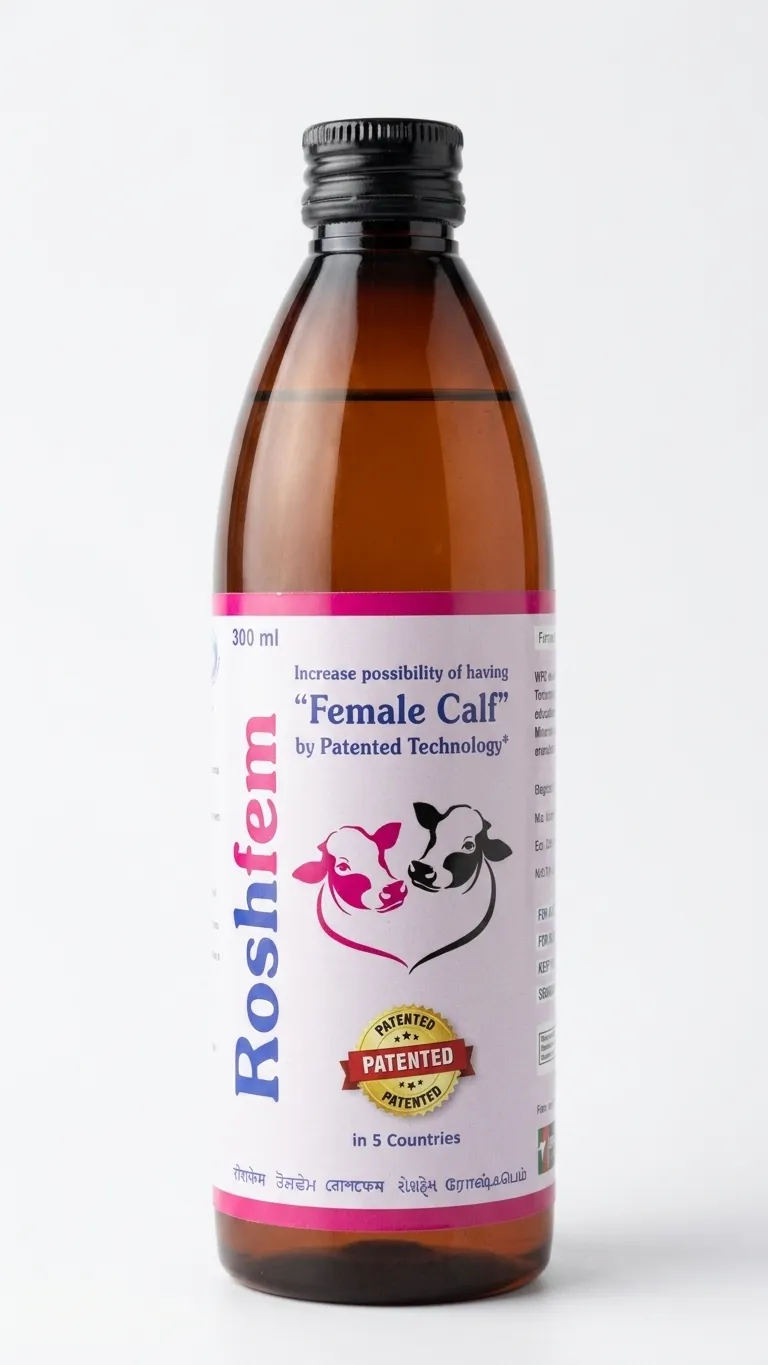
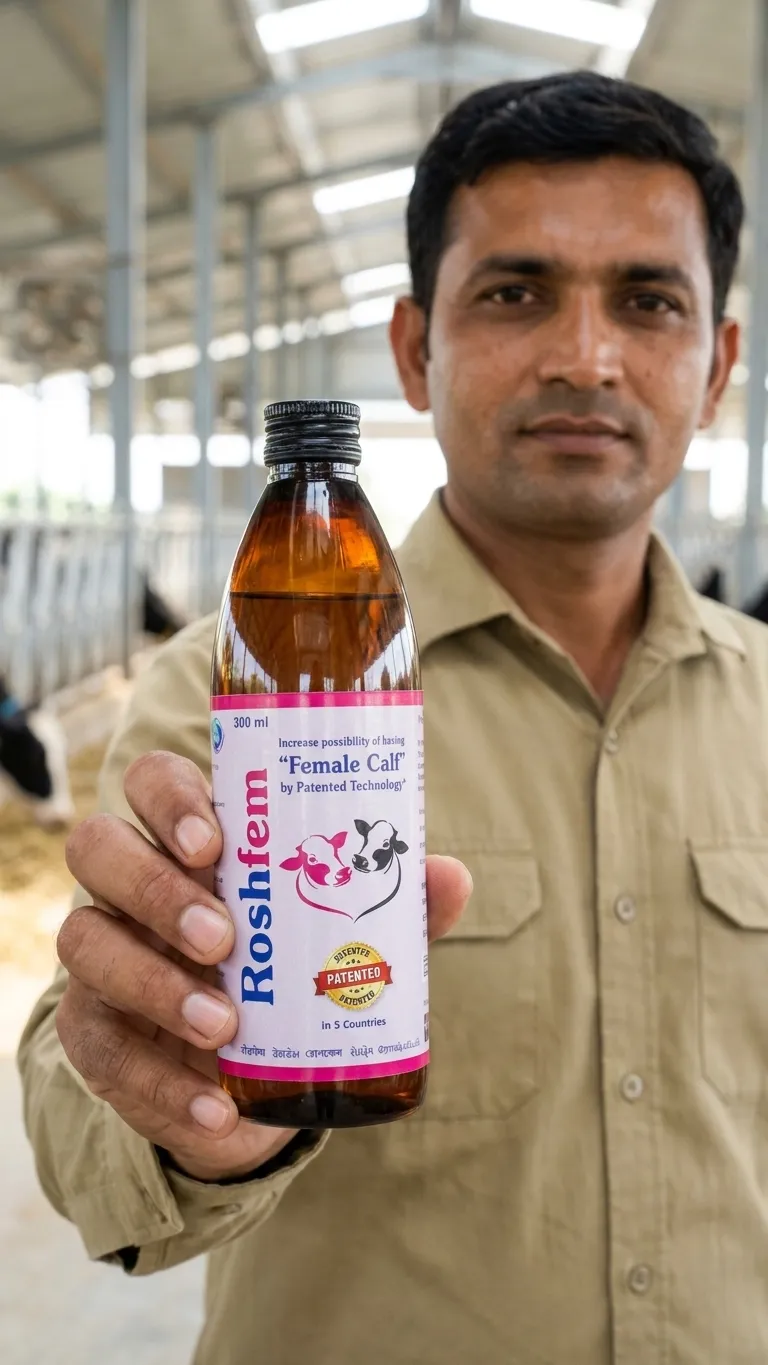
A 300 ml bottle, given by mouth
No syringe, no technician, no cold chain, no change to how the animal is handled. That is most of why it reaches farms other interventions do not.
- Presentation
- 300 ml oral liquid
- Patent protection
- Five countries
- On the label
- The brand name is set in Devanagari, Gurmukhi, Gujarati, Bengali and Tamil alongside the Latin script — the dairy belts it is sold into.
Product information
How it is used
- Form
- Liquid, administered orally
- Timing
- At least 20 minutes before each artificial insemination
- Dose
- Minimum 225 ml up to 450 kg body weight; 300 ml up to 600 kg body weight
- Preparation
- Mix with an equal quantity of water before administering
- Storage
- Cool, dry place, not exceeding 25 °C
Composition. The finished preparation contains ingredients selected from derivatives of ethanoic acid, sodium salt, edible-grade pharmaceutical aids and accepted additives.
In the bloodstream
- Effective in bloodstream
- 25–30 minutes after administration
- Total absorption
- Around 92%
- Active concentration in blood
- Around 80–85%
- Concentration retained in blood
- 35 minutes to 24 hours
Complete elimination — no residue in milk. For a milk union or a cooperative this is the first question asked, and the one that decides whether the conversation continues.
For best results
- Confirm the animal is in proper heat
- Avoid antibiotics or steroids in the 24 hours before use
- Follow the recommended dose for body weight
Possible side effects
- The animal may go off feed for a period
- Mild rash in the mouth
Added advantages
What it gives you beyond the ratio
- Improved conception rate
- When used to the standard protocol.
- Congenitally compatible
- Economical and cost effective
- Meaningfully cheaper than sexed semen.
- Ease of handling
- No cold chain, no specialised equipment.
Who it is for
- Small and marginal dairy farmers
- Breed and rear female calves instead of buying animals — saving purchase cost and creating income from sale.
- Milk unions and cooperatives
- Raise the milk-producing capacity of an entire member base.
- State animal husbandry departments
- Address herd improvement and stray cattle together, through existing AI infrastructure.
- Breed improvement programmes
- Accelerate genetic progress without narrowing the available gene pool.
Deploying at scale
It fits the infrastructure you already have
Roshfem needs no cold chain, no semen sexing facility, and no change to the insemination itself — only the administration protocol. Where an artificial insemination programme already runs, Roshfem can be added to it.
Results depend on administration following the recommended protocol.
The economics are straightforward
A female calf is an asset that produces for years. A male calf is a cost. Roshfem changes the odds between them — using the insemination programme already in place, with seven institutions' worth of evidence behind it.
Rosni Agri Information Pvt Ltd — AgroVet Division
Shikhar Complex, Khasra No. 313, Near Old SRM College, Modinagar, Ghaziabad, Uttar Pradesh
Animal feed supplement. Not for human use. IPR licensed by Profem Technology Limited, New Zealand and Profem Genesis Private Limited, India. Data taken from government documents and other verifiable published sources.